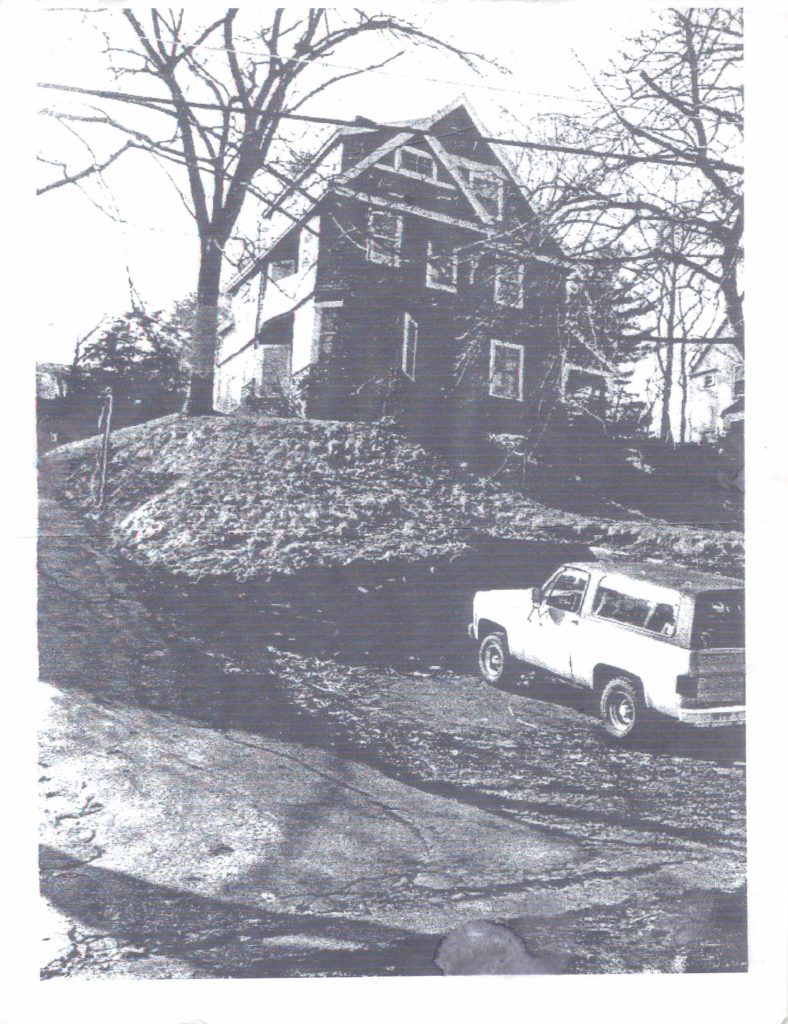
We got this report from the Newton Historical Society.
Architectural Significance
This is one of a group of Queen Anne houses which explored for their suburban owner the possibilities of a special effect and decorative design. Here an offset gable pavilion with decorated gable field tops a 2 story bay window. The gables as well as a band just above the slight “Garrison overhand” have pattern shingle. a porch which extends to the side has simple cut brackets, while the bracket which support the overhanging gable has a starburst motif resembling that of the gable field. An inset balcony at the side has a bowed hood above it, a commonly used shingle style effect.
Historical Significance:
In 1883 a hotly debated proposal for the town to buy the still wild and lovely 174 acres surrounding Bullough’s Pond for a central park for $87,000 failed as too costly for the City of Newton. Thereafter, much of the property was purchased by George Morse and the Newton Land Improvement Company. Streets were laid out and house lots surveyed. Four houses on Grove Hill were built in 1887, but the plots on Grove Hill Park did not sell till after 1907.
Atlas and Directory show
1907: Ed K. Hall, Lawyer, Boston
1895 Emily H. Potter (and 1891)